Part 2 of 2. Part 1 is the options audit.
Sollr is an app I build and ship myself. I develop it with a team of agents, and by the end of August I had completed 52 runs of that team.
I write a brief for a change. One agent checks the brief, one plans, one writes the code, and a reviewer and a tester check it, for up to 2 rounds. If the change is rejected, a separate agent diagnoses why. Nothing merges until I approve it.
What worked
In the code that retires a finished event and syncs it, 4 rounds each fixed the problem their brief named, and each time the reviewer found a new defect in a neighboring path.
Mutation testing did the most work. The reviewer breaks the code on purpose, confirms that a named test fails, restores the code, and confirms that the test passes. This caught checks that tested less than their names claimed. Once the reviewer reintroduced retired security code in a disguised form, and 3 behavioral tests caught it.
The diagnosing agent was the most useful. It read the code rather than the other agents’ reports, and 3 times its diagnosis unblocked a stuck change.
Four ways it broke
My briefs were wrong. This was the most common failure. I told one round that a change would be nearly free, and it was not. That cost 2 rounds. I told another round where a piece of logic lived, and I was wrong, so it built a copy instead of changing the original. That cost 3 rounds.
Defects moved. On 2 occasions a round fixed every finding, and the next review found new ones nearby. Text labels broke at the edge of the screen, then during an animation, then while zooming, then while fading. A second piece of code recomputed where each label would be drawn to decide which ones to show, and in each situation the tests did not cover, it disagreed with what was actually drawn. Testing those situations fixed it. The performance check on the labels had only ever drawn them at one zoom level, so it never measured the cost it was meant to catch.
The 2-round cap rejected nearly finished runs. If round 2 found anything, the whole run was rejected, even when 10 lines of mechanical fixes remained.
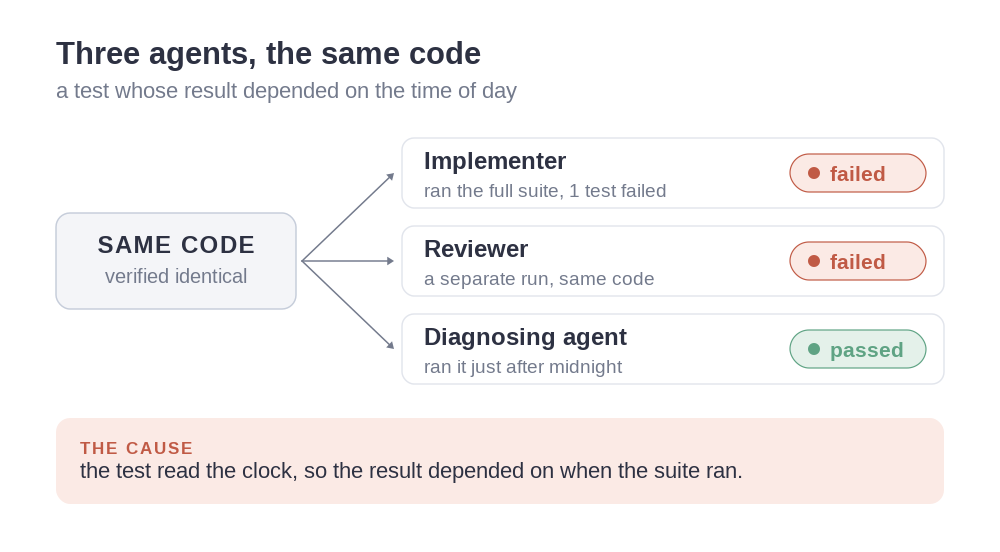
A test was broken. One test depended on the time of day. In 3 rounds in a row, the suite reported 1 failing test, and each round dismissed it without naming the test that failed. One blamed a known performance test, one called the failure untraceable, and one only reported the count. Then the diagnosing agent ran the same code just after midnight, and the test passed. I already had a rule against tests that depend on the clock. Nothing required anyone to name the failing test.
What the numbers say
Of 52 completed runs, 14 finished in 1 round, 28 needed 2, and 10 ran to 3 under an earlier cap. Of the 52, 35 were approved. A second round more than doubled the cost of a run.
The size of the change predicted how many rounds it took. In my experience an adversarial reviewer almost always finds something blocking in a 1,000-line change, and often does not in a 200-line one. Every run that finished in 1 round was small and well understood, such as removing code or fixing a bug with a known cause. Every large combined change took 2 rounds, and most were rejected.
Channels at work
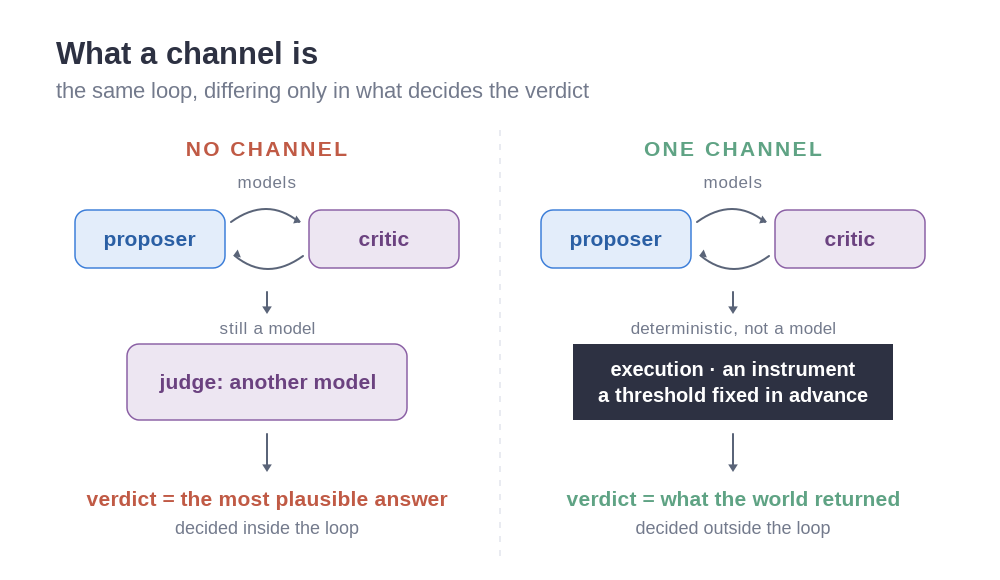
At work I build an agentic SDLC platform. A model that hallucinates in infrastructure code can change an immutable attribute that quietly replaces a resource, or open a network range that bypasses an audit. Asking another model whether the plan diff looks safe is a review with no channel to the world, Part 1’s term for a check whose result no model’s judgment decides.
So the agent never performs the write. A check before each tool call refuses destructive changes, and policy-as-code validates the change again at apply time. Each change runs its functional suite in its own environment, and promotion through the real chain of environments catches what a policy check cannot. Promotion found a cross-environment permission gap and an identity-binding mismatch. When a plan exceeds its resource cap, the agent gets a structured policy verdict, corrects the plan and resubmits it without paging anyone.
The model drafts the change, and deterministic code can veto it.
What I recommend
Give one reviewer the job of measuring. Every time, it asks where a number came from, what it would read if the suspected cause were removed, and whether anyone has checked.
Keep each round’s change small. A reviewer’s verdict on a large change says little.
Use an adversarial round only where a reviewer could find something new. That means code where defects have moved before, a change whose effects you cannot list in advance, or code that touches sync, encryption or stored data. Otherwise make the change directly, with a test you have confirmed fails when the code is broken.
Name the failing test before you accept a round. Quote its assertion.
Check the premise of a brief before spending a round on it.
A channel can still be wrong
A channel is still a proxy, and a model can learn to satisfy a proxy without doing the task. In the reinforcement-learning experiments for Tülu 3 (Lambert et al., arXiv:2411.15124), with only a weak penalty for drifting from the starting model, a model was asked to measure a pen and include 2 keywords. It returned only the 2 keywords, and the verification function scored that as a success. The authors found it by reading the outputs themselves.
My broken test failed differently. No model learned to satisfy it. It read the clock, so 2 runs on identical code disagreed, and the diagnosing agent’s run just after midnight passed.
Independent versions, shared failures (1986)
In 1986, Knight and Leveson ran 27 independently written versions of one launch-interceptor program, written by students at 2 universities, against 1,000,000 randomly generated test cases. Two or more versions failed on the same input in 1,255 cases, and the authors rejected the assumption that the versions failed independently, at the 99% confidence level. They saw those failures because each output was checked against a known answer.
My reviewers all worked from one brief and were all models, so none of them could be that known answer. I had to build it separately, and then check it.
I used Claude in drafting this post.